
When a patient receives a surgical indication for endometriosis, one of the first questions is usually about the technique used:
Is robotic surgery better than laparoscopy?
The word robotic suggests a more modern, precise and advanced technology. It is therefore understandable to imagine that surgery performed with robotic assistance would necessarily produce better results.
However, the available evidence does not demonstrate universal superiority of robotic surgery over conventional laparoscopy in the treatment of endometriosis.
Both are forms of minimally invasive surgery. Both can allow identification and excision of lesions, release of adhesions and treatment of involved organs.
What is laparoscopic surgery for endometriosis?
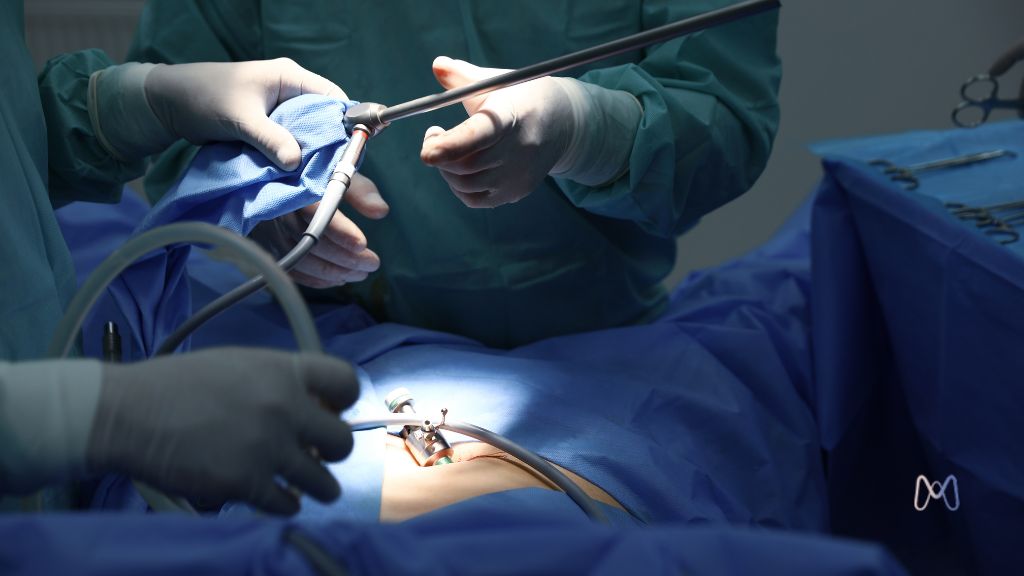
In laparoscopy, the surgeon makes small abdominal incisions. A camera is introduced to enlarge pelvic visualization, while long delicate instruments are used to treat the lesions.
The surgeon remains beside the patient and moves the instruments directly. The image is transmitted to a monitor, allowing identification of structures and precise movements.
Laparoscopy replaced many open surgeries for endometriosis because it allows treatment of different pelvic regions through a less invasive route.
How does robotic surgery work?
Robotic surgery also uses small incisions, a camera and instruments introduced into the abdomen. The difference is that these instruments are connected to a robotic platform.
The surgeon controls the movements from a console inside the operating room. The robot does not make decisions, does not identify lesions by itself and does not perform surgery autonomously. Every movement depends on the surgeon.
The platform may offer enlarged three-dimensional vision, articulated instruments and filtering of small tremors. These features can facilitate certain movements or access to specific regions.
Are robotic surgery and laparoscopy different surgeries?
From the standpoint of access route, both belong to minimally invasive surgery. In both, the abdominal cavity is accessed through small incisions and the team works guided by imaging.
The main difference is how the surgeon controls the instruments. In conventional laparoscopy, control is direct. In robotic surgery, movements performed at the console are reproduced by the platform arms.
This means robotic surgery does not replace surgical reasoning. It offers a different tool to execute a plan that still depends on the team's knowledge and experience.
Can the robot find lesions that laparoscopy cannot find?
No. Lesion identification depends on anatomical knowledge, exam interpretation, systematic pelvic inspection and the surgeon's ability to recognize different presentations of endometriosis.
Camera quality and magnification can help visualization, but they do not automatically turn an incomplete surgery into a complete one.
A lesion not recognized by the surgeon may still be missed, whether or not the instruments are connected to a robotic platform.
Is robotic surgery more precise?
The robotic platform offers articulated instruments and three-dimensional vision, features that may favor dexterity in limited spaces and certain angles.
However, technological precision is not automatically the same as a better clinical result. To demonstrate superiority, it would be necessary to observe consistent benefits in outcomes that matter to the patient, such as complications, pain, recovery, recurrence, organ preservation and quality of life.
Comparative studies published so far generally show similar surgical outcomes between the two routes. A 2024 systematic review and meta-analysis concluded that robotic surgery was not inferior to laparoscopy in perioperative outcomes.
What do studies show about complications and bleeding?
Reviews and comparative studies have not identified a consistent advantage of robotic surgery regarding bleeding, complications or need for conversion to open surgery.
This does not mean the two techniques will always produce the same result in every hospital or with every team. Studies compare groups of patients and do not eliminate the influence of individual surgeon experience, disease complexity and available structure.
The most prudent conclusion is that both can be safe when well indicated and performed by qualified teams.
Is recovery faster with the robot?
Because both use small incisions, both routes can provide the benefits associated with minimally invasive surgery, such as less aggression to the abdominal wall and recovery different from open surgery.
There is no consistent evidence, however, that using the robot necessarily produces faster recovery than well-performed laparoscopy.
Recovery time also depends on the extent of surgery. An operation involving bowel, bladder, ureter or multiple pelvic regions tends to have a different recovery from a less extensive procedure, regardless of the platform used.
Can robotic surgery take longer?
Some studies have identified longer operative time in robotic surgery. This may involve platform setup, arm positioning and procedure characteristics.
Time also varies according to the team's experience with the equipment. As the surgeon and operating room staff move along their learning curve, some steps may become more efficient.
Even so, duration should not be analyzed in isolation. A shorter surgery is not automatically better, just as a longer operation is not necessarily more complete. What matters is the reason for the difference and the result obtained safely.
In which situations can the robot make a difference?
Dr. Maurício uses robotic surgery and recognizes situations in which its resources may be especially useful. In the interview guiding this content, he mentions a case of extensive diaphragmatic endometriosis, in a location where instrument articulation helped execution.
The platform may offer technical advantages in situations such as:
- Regions with difficult access or angulation
- Narrow anatomical spaces
- Need for delicate suturing movements
- Cases involving specific reconstructions
- Procedures in which instrument articulation improves ergonomics
- Patients with obesity
These possible advantages do not make the robot the best option for every patient. A specific usefulness should not be turned into a universal promise.
When can conventional laparoscopy be sufficient?
Laparoscopy can treat less extensive cases as well as complex deep endometriosis surgeries, provided the team has adequate training and structure.
It may be chosen when:
- The surgeon has extensive experience with this route
- Mapping shows disease that can be adequately treated by laparoscopy
- The available instruments are sufficient for the plan
- No concrete technical advantage is expected from the robot
- The robotic platform is unavailable or would add cost without demonstrated benefit
Not using the robot does not mean performing outdated surgery. Laparoscopy remains an advanced and consolidated technology.
Does surgeon experience matter more than the platform?
Experience remains central because the surgeon interprets the mapping, recognizes altered anatomy, identifies lesions, protects organs and decides how to execute each step.
Equipment can expand technical capabilities, but it does not replace:
- Knowledge of the different forms of endometriosis
- Experience with complex pelvic anatomy
- Ability to interpret preoperative mapping
- Judgment to decide what should or should not be treated
- Management of possible complications
- Integration with professionals from other specialties
An experienced surgeon may perform excellently with laparoscopy. Another may benefit from the robot in a specific situation. The choice must respect the team's real competence in each method.
Does the multidisciplinary team change according to technology?
The need for a multidisciplinary team depends mainly on the organs involved, not on the name of the platform.
When there is possible bowel, urinary, diaphragmatic or other regional involvement, participation of surgeons from different specialties may need to be planned.
The robot does not eliminate this need. Likewise, conventional laparoscopy does not prevent integrated work. Planning should begin with disease mapping, not with the equipment in the room.
Should cost be part of the decision?
Yes. Robotic surgery may involve additional costs related to the platform, instruments and hospital structure.
Cost should not be the only criterion, but it must be part of a transparent decision. When there is a concrete technical advantage for that patient, the benefit may justify the choice. When expected results are equivalent, the additional cost should be clearly discussed.
Higher-cost technology should not be used as a synonym for better care without clinical justification.
Does the type of surgery influence recurrence risk?
Endometriosis recurrence does not depend only on the technique used. It may be influenced by disease characteristics, lesion extent, surgical strategy, treatment performed, age, reproductive goals and follow-up.
There is not enough evidence to state that choosing the robot by itself reduces recurrence compared with well-performed laparoscopy.
More important than the name of the technology is understanding the goal of surgery, which lesions will be excised, which structures need to be preserved and how follow-up will occur.
How should the choice be presented to the patient?
The patient should not receive only the information that one technology is more modern. She needs to understand why a given route was proposed for her case.
Some questions help in this conversation:
- What is the goal of surgery?
- Which organs may be involved?
- Why was this technique chosen?
- Is any specific benefit expected?
- Does the team have experience with both techniques?
- Are there relevant differences in risk, cost or recovery?
- Will a multidisciplinary team be necessary?
- What may happen if the strategy needs to change during the operation?
A good indication can be explained without relying on technological slogans.
The best method may change according to the case
A technology may be very useful without being necessary in every situation. It may facilitate a specific operation without improving every outcome. It may be the best choice for one patient and add no concrete benefit for another.
This distinction protects medical decision-making from two extremes: rejecting an innovation only because it is new or adopting it indiscriminately only because it seems more advanced.
Conclusion
Robotic surgery and conventional laparoscopy are two minimally invasive approaches that can be used in the treatment of endometriosis.
So far, studies do not demonstrate universal superiority of robotic surgery in outcomes such as complications, bleeding, hospital stay or recovery. Some studies identify longer operative time and cost with the robotic platform.
This does not mean the robot has no value. Its articulated instruments, three-dimensional vision and ergonomics can help in specific locations or movements. The benefit must be demonstrated within the concrete case.
The question should not be which technology seems more modern. It should be which strategy allows that disease to be treated safely, with planning and respect for the patient's goals.
Technology expands the surgeon's possibilities. It does not replace experience, judgment or responsibility.
Frequently asked questions about robotic surgery and laparoscopy for endometriosis
Is robotic surgery better than laparoscopy for endometriosis?
There is no demonstrated universal superiority. Both techniques can be safe and effective. The choice depends on disease location, case complexity, team experience and available resources.
What is the difference between robotic surgery and laparoscopy?
In both techniques, surgery is performed through small incisions and guided by a camera. In laparoscopy, the surgeon moves the instruments directly. In robotic surgery, the surgeon controls the platform arms from a console.
Does the robot perform the surgery by itself?
No. The robot does not make decisions or perform movements autonomously. The entire operation is controlled by the surgeon.
Is recovery faster with robotic surgery?
Not necessarily. Both are minimally invasive surgeries, and recovery also depends on procedure extent, involved organs and patient characteristics.
Does robotic surgery cause fewer complications?
Available studies do not show a consistent reduction in complications compared with conventional laparoscopy. Both can be safe when performed by qualified teams.
In which cases can the robot be useful?
It may help in hard-to-access regions, narrow spaces, delicate suturing movements or situations in which instrument articulation offers a concrete technical advantage.
Can conventional laparoscopy treat deep endometriosis?
Yes. Laparoscopy can be used in complex deep endometriosis surgeries when the team has adequate experience and structure.
Does robotic surgery reduce endometriosis recurrence?
There is not enough evidence to say that using the robot by itself reduces recurrence compared with well-performed laparoscopy.
What is more important than the technology used?
Correct indication, disease mapping, team experience, multidisciplinary planning and the ability to treat lesions while preserving organs and functions.