
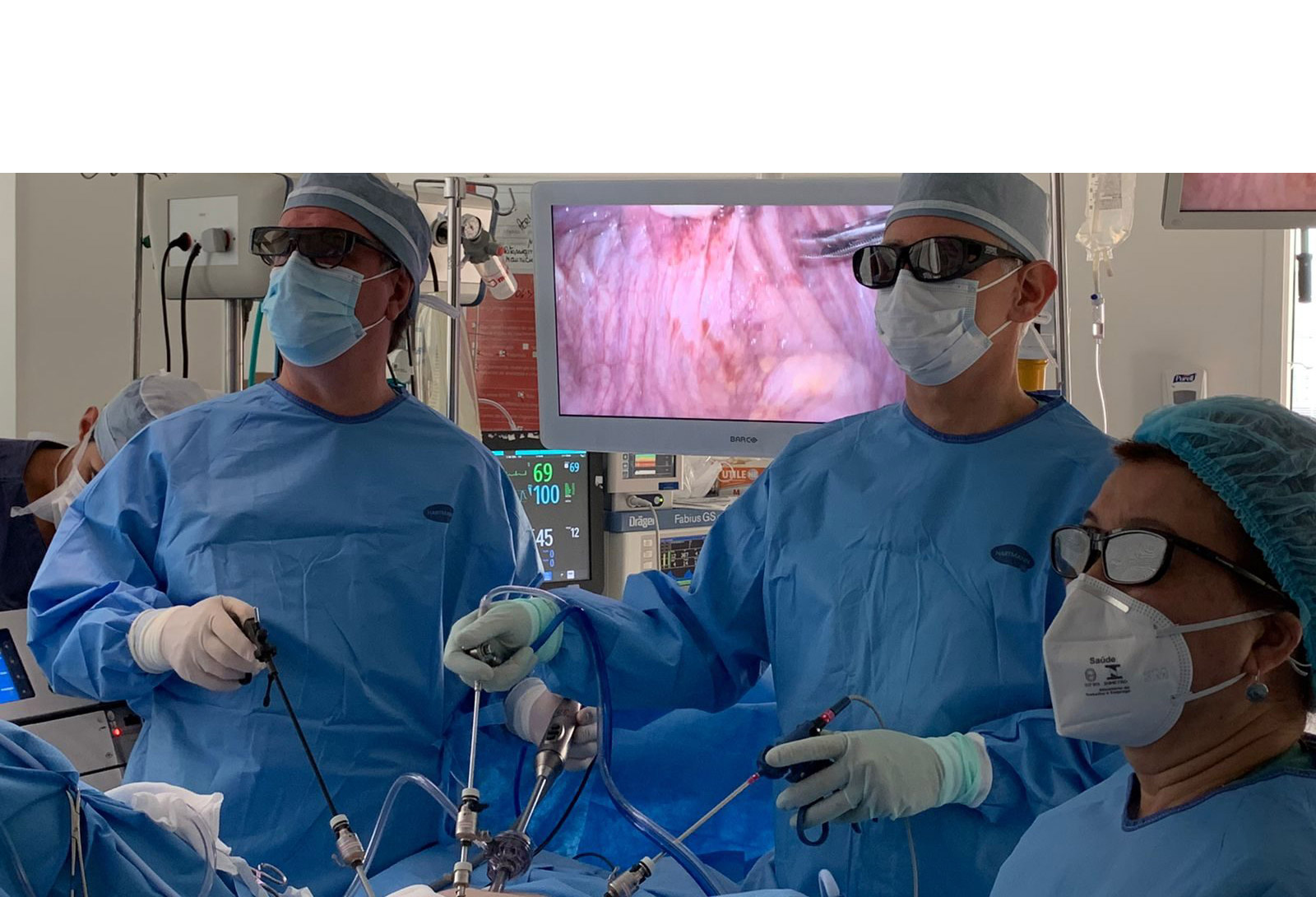
What is gynecological robotic surgery?
Gynecological robotic surgery is a minimally invasive approach in which surgical instruments and a camera are introduced through small incisions. The surgeon controls the system from a console and follows the procedure through an enlarged, three-dimensional image.
The technology may expand visualization and instrument movement in selected situations. Its use, however, depends on the diagnosis and an individualized assessment.
How does robotic surgery work?
Surgical planning
The team reviews the diagnosis, tests, medical history, health conditions and treatment alternatives.
Anesthesia and incisions
The procedure takes place in a hospital, with anesthesia and incisions compatible with the chosen technique.
Surgeon control
The surgeon controls the instruments and camera through a console. The robot does not operate alone or make clinical decisions.
Recovery and follow-up
Recovery depends on the procedure, case complexity, health conditions and the patient's individual response.
When may robotic surgery be considered?
It may be discussed when a minimally invasive approach is clinically appropriate and the platform could contribute to planning a specific gynecological procedure.
More complex endometriosis
In selected cases, robotic surgery may be discussed as one of several surgical approaches after a specialized assessment.
Complex gynecological surgery
The platform may be considered when anatomy, disease location or previous surgery requires detailed technical planning.
Having one of these situations does not mean robotic surgery will be recommended. The best approach depends on assessment and discussion of alternatives.
Robotic, laparoscopic or open surgery: which approach is appropriate?
All three approaches may have valid indications. This comparison is informational and does not determine which technique should be used for an individual case.
| Criterion | Robotic surgery | Laparoscopy | Open surgery |
|---|---|---|---|
| Access | Small incisions when compatible with the procedure. | Small incisions when compatible with the procedure. | A larger incision defined according to the operation. |
| Visualization | Enlarged three-dimensional image through the system. | Camera and monitor visualization. | Direct view of the surgical field. |
| Instruments | Controlled by the surgeon from the console, with articulated movements. | Controlled directly by the surgeon. | Conventional surgical instruments. |
| Possible uses | Selected cases where the platform may contribute technically. | Many minimally invasive procedures. | Situations where open access is more appropriate or necessary. |
| Limitations | Not appropriate for every patient or procedure. | May not be the best route for certain complex cases. | A different approach with its own preparation and recovery. |
| Selection criteria | Diagnosis, complexity, anatomy, history, risks, alternatives, team experience and patient goals. | ||
There is no single rule. Laparoscopy, robotic surgery, open surgery or non-surgical treatment may be considered depending on the condition.
What are the possible benefits and limitations?
Possible benefits in selected cases
- Minimally invasive approach.
- Enlarged view of the surgical field.
- Instruments with a broader range of movement.
- Possible access to complex pelvic areas.
- Individualized technical planning.
Limitations and points to assess
- Not every patient is a candidate.
- Technology does not replace team experience.
- Laparoscopy or open surgery may be more appropriate.
- Every surgery involves risks and informed consent.
- Recovery varies according to the procedure and clinical condition.
How is an indication for robotic surgery determined?
Diagnosis and treatment goal
Assessment of the condition, symptoms, tests, effects on daily life and care goals.
Case complexity
Review of location, extent, previous surgery, adhesions, anatomy and other clinical factors.
Discussion of alternatives
Comparison of clinical follow-up, laparoscopy, robotic surgery, open surgery or other possibilities.
Shared decision
Explanation of benefits, risks, limitations, preparation and expected recovery before a decision.
How do preparation and recovery work?
Before surgery
Preparation may include a preoperative visit, test review, anesthesia assessment, medication and fasting instructions, and planning for recovery. Instructions vary by procedure and health condition.
After surgery
Follow-up is defined according to the procedure and individual progress. The team provides guidance about appointments, incision care, activities and complementary follow-up.
Integrated care for complex gynecological cases
When indicated, care may integrate endometriosis, endometriosis mapping, gynecological surgery, advanced gynecology, urogynecology, human reproduction and pain management.
Not every patient will require multidisciplinary care.

Prof. Dr. Mauricio Abrão
CRM-SP 52.842
Gynecology and Endometriosis
In-person care and teleconsultations
Medicina da Mulher provides in-person assessments in São Paulo and teleconsultation guidance for patients elsewhere, according to clinical needs and applicable rules.
Determining a surgical indication may require an in-person assessment, physical examination, test review and detailed discussion with the medical team.
Learn about our medical team and international patient service.